

By Paul Romano, Romano & Sumner, PLLC — Board Certified in Estate Planning and Probate Law, Texas Board of Legal Specialization
Quick Answer
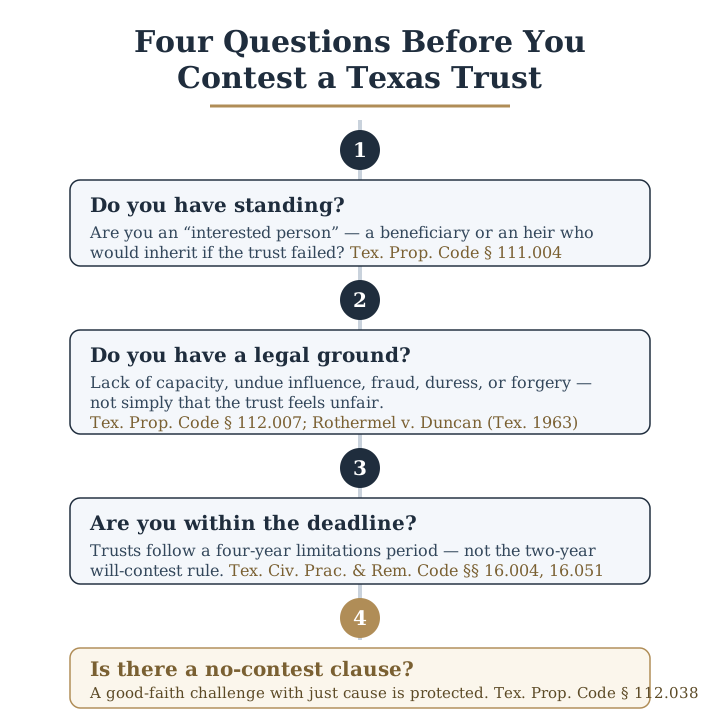
To contest a trust in Texas, you must be an “interested person” (usually a beneficiary or an heir who would inherit if the trust failed), and you must file suit on a recognized legal ground: lack of capacity, undue influence, fraud, duress, forgery, or improper creation. Unlike a will contest, which generally must be filed within two years, a trust challenge falls under Texas’s four-year limitations period, and when that clock starts can depend on the facts, including when you discovered the problem. At Romano & Sumner in Sugar Land, we handle these disputes across Fort Bend and Harris County. Because deadlines and no-contest clauses can cost you your inheritance, talk to a lawyer before you act.
When a parent dies, and the trust doesn’t say what you expected, the questions come fast. A sibling ends up with everything. A caretaker who showed up last year is suddenly the trustee. The document was signed when your mother could barely recognize you. Can I do anything about this? Is it too late? Will I lose my share just for asking?
You can do something about it, but Texas law is specific about who can challenge a trust, on what grounds, and by when. Getting those three things right is the whole ballgame. Here’s how it works.
Yes — but not everyone can, and not for any reason.
Texas law lets an “interested person” bring a trust dispute. That’s defined broadly to include a trustee, a beneficiary, or anyone else “having an interest in or a claim against the trust” or who is “affected by the administration of the trust” (Tex. Prop. Code § 111.004(7)). In plain terms: if you’re named in the trust, or you’re an heir who would have inherited had the trust never existed, you almost certainly have standing to challenge it. A neighbor who thinks the split was unfair does not.
Standing is only the first gate. You also need a legal ground (a real defect in how the trust was created), and you need to be inside the deadline. Miss either one and the strength of your story won’t matter.
You can’t contest a trust simply because it’s unfair or because you were left out. You have to show the trust, or an amendment to it, is legally invalid. In Texas, the recognized grounds are:
One distinction people get wrong: contesting a trust and suing a trustee are two different fights. If the trust is valid but the trustee is stealing, self-dealing, or refusing to account, that’s a breach of fiduciary duty claim against the trustee — not a contest of the trust itself. Both can be brought in the same lawsuit, but they rest on different law and different proof. Knowing which one you actually have changes the entire strategy.
This is where trusts differ sharply from wills, and where people get burned.
A will contest in Texas generally has to be filed within two years of the will being admitted to probate (Tex. Est. Code § 256.204) — see our guide to contesting a will in Texas. Many people assume the same short clock applies to trusts. It doesn’t.
Texas has no single statutory deadline dedicated to trust contests. Instead, these claims fall under the general four-year limitations period that governs fraud and breach of fiduciary duty, and the residual four-year period that catches claims with no specific deadline of their own (Tex. Civ. Prac. & Rem. Code §§ 16.004, 16.051). The harder question is usually when the four years start running — which can depend on when you knew, or reasonably should have known, that something was wrong. That is a fact-specific question, and it’s exactly the kind of issue you don’t want to guess about.
The practical takeaway: don’t wait. Even though four years sounds like a lot of runway, evidence disappears, witnesses’ memories fade, and trustees distribute assets. The sooner you get advice, the more options you have.
Maybe. This is the single most important thing to understand before you file anything.
Many Texas trusts contain a forfeiture clause (also called an in terrorem or “no-contest” clause): challenge the trust and you forfeit whatever it left you. Texas enforces these clauses — but not absolutely. Under Tex. Prop. Code § 112.038, a forfeiture clause will not be enforced against you if you prove, by a preponderance of the evidence, that (1) you had just cause for bringing the action and (2) you brought and maintained it in good faith.
In other words, a good-faith challenge backed by real evidence generally won’t cost you your inheritance — but a fishing expedition can. And the statute also protects a beneficiary’s right to make a trustee do their job: forfeiture clauses generally aren’t read to punish you for demanding an accounting or holding a trustee to their duties. Whether your facts clear the just-cause-and-good-faith bar is a judgment call worth making with a lawyer, before you file — not after.
From our attorneys — Paul Romano
In one matter, we represented a trust beneficiary who had every reason to be upset: the trustee had gone silent for months — no accounting, no straight answers about what the trust held — while the administration stalled and fees climbed. On the merits, the complaint was legitimate. The problem was the trust instrument. It carried an unusually broad no-contest clause — the kind that disinherits any beneficiary who challenges the trust or the trustee “in any manner.” If the client filed and lost, the loss wouldn’t be just the case; it would be the entire inheritance.
So before filing anything, we worked the question Texas law actually turns on. Under Tex. Prop. Code § 112.038, a forfeiture clause can’t punish a beneficiary who acts with just cause and in good faith — and it has no effect at all on one who simply asks the court to make the trustee do its job or account for a breach. We went through the facts one at a time, then drafted every count as a request to enforce the trust and hold the trustee accountable, never to contest it — keeping the case inside the statute’s protection. The rule in the code is one sentence. Knowing whether a specific set of facts actually fits inside it, before you stake a client’s entire inheritance on the answer, is the part that takes judgment.
Usually not, and this trips up a lot of families.
While the settlor is alive and competent, a revocable trust is theirs to change. Texas law lets a settlor revoke, modify, or amend a revocable trust more or less at will (Tex. Prop. Code § 112.051). If Mom can legally rewrite her trust tomorrow, a beneficiary has nothing settled to attack today. The real window to contest most trusts opens when the trust becomes irrevocable, typically at the settlor’s death (or, in some situations, when the settlor loses capacity).
There’s a related tool worth knowing: a court can modify, reform, or even terminate a trust in certain circumstances — for example, when the trust’s purpose has become impossible, or to fix a scrivener’s error that defeats the settlor’s actual intent (Tex. Prop. Code § 112.054). That’s not the same as a contest, but for a beneficiary stuck with a broken or outdated trust, it’s sometimes the better path.
It depends on your county. Texas district courts have original and exclusive jurisdiction over trust proceedings across the state (Tex. Prop. Code § 115.001). But in counties that have a statutory probate court (Harris County has several), that court hears trust disputes too, including actions involving inter vivos, testamentary, and charitable trusts (Tex. Est. Code § 32.006). Some matters can also fall to a county court at law (Tex. Prop. Code § 115.001(d)).
For families in Fort Bend County, Sugar Land, and the greater Houston area, that means the right courthouse isn’t automatic — it turns on where the trust is administered and which courts your county has. It’s a detail worth confirming early, because filing in the wrong court costs time you may not have.
Trust contests are among the most document-heavy, emotionally loaded cases in Texas estate law, and they’re squarely what we do. Romano & Sumner is a Sugar Land probate, guardianship, and estate-litigation firm serving families across Fort Bend County and Harris County, with a dedicated Sugar Land trusts practice. When you bring us a trust dispute, we:
Our estate-litigation work is led by partners Paul Romano, Kenneth “Kenny” Sumner Jr., and Nicholas “Nick” Noe. If you think a trust doesn’t reflect what your loved one actually wanted, call us at (281) 242-0995 for a free consultation. The first conversation costs you nothing, and it may be the one that tells you whether you have a case.
Do I have to be named in the trust to contest it? No. You need to be an “interested person” (Tex. Prop. Code § 111.004(7)). That includes beneficiaries, but also heirs who would have inherited if the trust were set aside. A person with no financial stake generally can’t contest.
Is contesting a trust the same as suing the trustee? No. Contesting a trust attacks whether the trust itself is valid. Suing a trustee for mismanagement, self-dealing, or refusing to account is a breach-of-fiduciary-duty claim against a valid trust. They’re different claims, though you can raise both in one suit.
Will I automatically lose my inheritance if I challenge a trust with a no-contest clause? Not automatically. Under Tex. Prop. Code § 112.038, the clause won’t be enforced if you prove you had just cause and acted in good faith. But a weak or bad-faith challenge can trigger forfeiture — get advice first.
Can I contest my parent’s trust while they’re still alive? Usually not, if it’s revocable — your parent can change it at any time (Tex. Prop. Code § 112.051). The contest window generally opens when the trust becomes irrevocable, typically at death.
How long do I have to contest a trust in Texas? There’s no dedicated trust-contest deadline like the two-year rule for wills. Trust challenges generally fall under a four-year limitations period (Tex. Civ. Prac. & Rem. Code §§ 16.004, 16.051), and when the clock starts can be fact-specific. Don’t wait to get advice.
This article is for general informational purposes only and is not legal advice. Reading it does not create an attorney-client relationship. Every situation is different — for advice about your circumstances, speak with a qualified Texas attorney.