

By Nicholas “Nick” Noe, Partner, Romano & Sumner, PLLC.
Quick Answer. If you’re fighting over a will, a trust, or the way an estate is being handled in the Sugar Land area, an estate litigation lawyer can usually tell you, in one free conversation, whether you have a real case and how much time you have to act. Romano & Sumner is a Sugar Land estate-litigation firm that handles will contests, trustee and executor misconduct, and beneficiary disputes in the Fort Bend County courts at law and the Harris County statutory probate courts. Most will contests have to be filed within two years of the day the will is admitted to probate (Tex. Est. Code § 256.204) — so the first move is finding out where you stand before the deadline decides for you.
Estate fights almost never start as fights. They start as a bad feeling — a will that doesn’t sound like the person who signed it, an executor who’s gone quiet, a trustee who won’t answer a simple question about money that’s supposed to be yours. By the time most people call a lawyer, they’ve spent months telling themselves they’re probably overreacting. Usually they’re not. This page walks through what estate litigation actually is, how to tell whether you have a case, the disputes we handle, and what working with us looks like, in plain English, with a link to the detailed guide whenever you want to go deeper.
Estate litigation is the part of probate that turns into a lawsuit. Most estates are administered quietly: someone probates the will, pays the debts, distributes what’s left, and the family moves on. Estate litigation is what happens when that breaks down: when someone challenges whether a will is valid, accuses the person in charge of mishandling money, or has to go to court to see an accounting they’re entitled to.
It covers two worlds that overlap more than people expect: wills and estates (probate court) and trusts (usually district court). The same family conflict often lives in both. The person who pressured Mom into rewriting her will frequently moved money into a trust or onto joint accounts at the same time. A firm that handles only one side of that can miss half of what’s actually going on.
Two questions decide almost every estate dispute before anything else matters: do you have standing, and are you inside the deadline?
Standing means you’re an “interested person”: an heir, a beneficiary named in the will, a spouse, a creditor, or someone else with a real property stake in the estate (Tex. Est. Code § 22.018). Hurt feelings aren’t enough; a real stake is. Timing is the one that quietly ends more cases than any weak fact ever does. A will contest generally has to be filed within two years of the date the will was admitted to probate (§ 256.204). The trap is that the clock often starts before you even hear the will exists; an executor only has to notify beneficiaries after the will is admitted. Families lose the right to contest not because they were wrong, but because they waited.
So the honest first step isn’t “do I have a great case.” It’s “do I qualify, and how much time is actually left.” That’s usually a short, free conversation — and it’s the one worth having now rather than after the deadline has passed.
Not sure whether your situation clears the standing-and-deadline bar? A short, free call with Romano & Sumner can tell you where you stand, and how much time is left, before the clock decides for you. Call (281) 242-0995.
“Estate litigation” is the front door. The dispute underneath it usually has a name. Here’s the short version of each, with a link to the detailed guide when you want the full treatment.
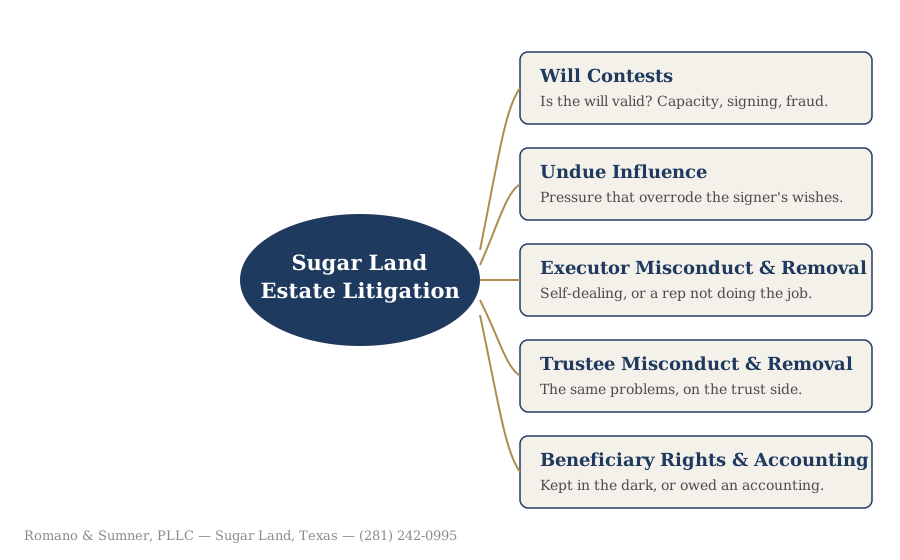
Whatever the label, the pattern is the same: someone with control is doing something the person who died would never have allowed — and someone has to be the one to stand up to it.
An estate lawsuit is filed in the court handling the estate, and which court matters more than most people realize. Harris County has dedicated statutory probate courts that hear these cases all day; Fort Bend County has no separate probate court, so contested estate matters run through its county courts at law (in Richmond), alongside the rest of their docket (Tex. Gov’t Code §§ 25.1034, 25.0812). We’re in these courthouses regularly, and how a case is received in Richmond is not always how it’s received in Houston.
You don’t have to figure this part out on your own. That’s the whole reason to call someone who lives in it. The single biggest factor in how hard a will contest will be is timing: whether you step in before or after the will is admitted to probate. Before admission, the person offering the will has to prove it’s valid. After the court admits it, that flips, and the challenger carries the burden. Because most people don’t learn of a problem until after admission, they end up fighting from the harder side. That isn’t a reason to give up; it’s the reason to move early, while the evidence that decides these cases (medical records, witnesses, the financial trail) can still be gathered and preserved.
Local practice varies in ways the rulebook won’t tell you. Here’s one: several of the Fort Bend County courts at law still expect an in-person oral hearing on a motion for summary judgment under the newer rules, while some Harris County statutory probate courts, Court 4 among them, will decide the same motion on the written briefing alone. Get that wrong, and you either lose weeks waiting on a hearing you didn’t need, or miss one you did. We track how each court actually runs, not just what the rule says on paper — in a contested estate case, that difference gets measured in your time and your money.
We’re a Sugar Land probate, guardianship, and estate-litigation firm, and estate disputes are not a sideline for us — they’re the core of what we do. We’ve worked both sides of these cases: challenging wills and trustees that don’t hold up, and defending them against challenges that don’t. That’s the part that helps you most, because it means we can tell you early and honestly whether you have a real case or just a bad feeling, before you spend money finding out.
Estate-litigation matters at Romano & Sumner are handled by our partners: Paul Romano, Kenneth “Kenny” Sumner Jr., and Nicholas “Nick” Noe. Paul Romano is Board Certified in Estate Planning and Probate Law by the Texas Board of Legal Specialization.
Here’s the pattern we see most: families wait. They spend the first year stunned and the second year arguing, and the deadline closes somewhere in between. The most useful thing you can do is find out where you stand while you still have options.
If something about a loved one’s will, a trust, or the way an estate is being handled is bothering you, call Romano & Sumner at (281) 242-0995 for a free consultation, or reach us through our contact page. Bring whatever paperwork you’ve received, and we’ll help you understand your standing, your deadline, and what to do next.
What does an estate litigation lawyer do? An estate litigation lawyer handles disputes over wills, trusts, and estates: contesting or defending a will, removing an executor or trustee who’s mishandling things, and enforcing a beneficiary’s right to information and an accounting. It’s the litigation side of probate: what happens when an estate can’t be settled by agreement.
How much does it cost to hire an estate litigation attorney in Sugar Land? It depends on the dispute. Some matters, certain will contests in particular, can be handled on a contingency fee, meaning no attorney’s fees up front and none owed if there’s no recovery. Others are billed hourly. We’ll tell you honestly at the first meeting, which is free, how your case is likely to be structured.
How long do I have to bring an estate dispute in Texas? For a will contest, generally two years from the date the will was admitted to probate, with narrow exceptions for fraud, forgery, and incapacity (Tex. Est. Code § 256.204). Other estate and trust claims run on their own timelines. Because the deadline is the thing that most often ends a case before the facts ever matter, the safest move is to have a lawyer confirm your specific deadline early.
Do I need a lawyer, or can I handle an estate dispute myself? Practically, you need a lawyer. These are lawsuits with strict deadlines, formal proof requirements, and a burden of proof that often falls on you. The evidence that decides them has to be gathered and preserved early, and that’s very hard to do well on your own.
Do you handle estate litigation in Fort Bend County and Harris County? Yes. Our office is in Sugar Land, and we handle contested estate and trust matters in the Fort Bend County courts at law, the Harris County statutory probate courts, and the surrounding counties.
This article is for general informational purposes only and is not legal advice; it is not a promise or guarantee of any particular result. Reading it does not create an attorney-client relationship. Every situation is different. For advice about your circumstances, speak with a qualified Texas attorney.