

By K. “Gus” Vlahadamis, Of Counsel at Romano & Sumner, PLLC, focusing on the firm’s estate planning practice
Quick Answer
No. Texas has no state estate tax, inheritance tax, or gift tax. The only estate tax that can ever apply to a Texas family is the federal one, and as of 2026 it only reaches estates worth more than $15 million per person ($30 million for a married couple, if a portability election is made). Congress made that threshold permanent, with no scheduled expiration. For the overwhelming majority of Texas families, that means no estate tax return and no estate tax bill, full stop. Romano & Sumner helps Sugar Land and Houston-area families plan for the rare cases where it still matters.
No. Texas does not collect an estate tax, an inheritance tax, or a gift tax at the state level- none of the three. It doesn’t matter whether an estate is worth $50,000 or $50 million; the state of Texas takes nothing. As of November 2025, that is locked into the Texas Constitution. Voters approved Proposition 8, which added Article VIII, Section 26, barring the Legislature from ever imposing a state estate, inheritance, or death tax.
That surprises people, because they’ve heard “estate tax” and assume every state has one, or they’ve read something out-of-state that doesn’t apply here. It doesn’t. If you’re settling an estate in Fort Bend or Harris County, no Texas death tax applies. One caveat the post shouldn’t skip: another state’s tax can still reach a Texas family. Twelve states and the District of Columbia impose an estate tax, and five (Kentucky, Maryland, Nebraska, New Jersey, and Pennsylvania) impose an inheritance tax. If the decedent owned real property in one of those states, or if you’re inheriting from someone who lived in one, that state can tax the transfer even though Texas does not.
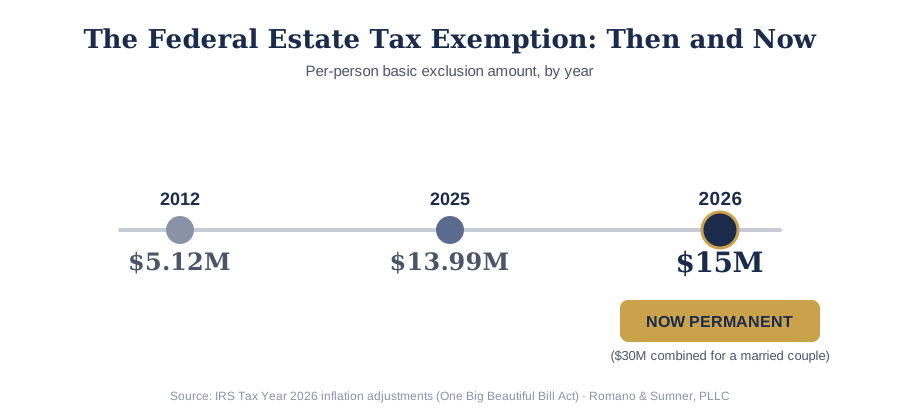
The only estate tax that can touch a Texas family is federal, and it only applies above a very high floor. For deaths in 2026, Congress set that floor, the basic exclusion amount, at $15,000,000 per person, up from $13,990,000 in 2025. A married couple can combine both spouses’ exemptions for $30,000,000, but only if they take one affirmative step. Combining requires a portability election, and that election is made only by filing a complete Form 706 for the first spouse to die, even though that estate owes no tax and would not otherwise have to file anything. Families who assume they’re comfortably under the limit routinely skip that filing and permanently forfeit the first spouse’s $15,000,000. If the deadline was missed, a late portability election is still available within five years of death where portability is the only reason to file.
That number isn’t a temporary policy that could reset in a year or two, either. Congress made it permanent under the One Big Beautiful Bill Act, signed July 4, 2025. Unlike the 2017 tax act, there is no scheduled sunset. The $15,000,000 is a fixed statutory figure for 2026; annual inflation indexing begins in 2027, using 2025 as the base year. (26 U.S.C. § 2010(c)(3), as amended by Pub. L. No. 119-21 (July 4, 2025); Rev. Proc. 2025-32.)
Compare that to just fourteen years ago: in 2012, the same exemption was $5,120,000, just over a third of today’s number. If you (or a parent) did estate planning back when that figure was the law, the plan may have been built around a tax problem that, for most families, no longer exists. That’s worth checking. Older plans often force assets into a bypass or credit shelter trust that no longer saves any estate tax and costs the family a second basis step-up at the surviving spouse’s death — worth understanding what a trust actually does before assuming yours still helps.
Separately from the estate exemption, the IRS also sets an annual gift tax exclusion, the amount you can give any one person each year without it counting against your lifetime exemption at all. For 2026, that’s $19,000 per recipient, unchanged from 2025. A married couple can give $38,000 to any one person gift-tax-free. No return is required if each spouse gives $19,000 of their own funds. If one spouse writes the entire $38,000 check and the couple wants it treated as half from each, that’s a gift-splitting election under 26 U.S.C. § 2513, and the election is made on a Form 709.
This only matters as a planning tool once an estate is realistically approaching the $15 million exemption. The annual exclusion still comes up for other reasons, including Medicaid look-back planning and funding a 529 for a grandchild.
For most Texas families, no. If your estate, counting your home, retirement accounts, life insurance, and everything else, is nowhere near $15 million, the federal estate tax was never going to touch you, and the 2026 increase doesn’t change your planning at all. Wills, trusts for minor children, powers of attorney, and avoiding probate headaches are still the real work. The estate tax isn’t part of it, but other taxes still are. Assets passing at death generally receive a stepped-up income tax basis under 26 U.S.C. § 1014, which is usually the largest single tax benefit an ordinary estate receives, and an inherited traditional retirement account is ordinary income to the beneficiary, typically on a ten-year withdrawal clock.
Firm partner Paul Romano, who is Board Certified in Estate Planning and Probate Law, sees this come up constantly. A client will sit down in our Sugar Land office and ask, almost apologetically, how much income tax their children are going to owe on what they leave them — usually having already done the math in their head and assumed the government takes a third of it.
The answer is a relief every time. Money or property your children inherit is not income to them. They don’t report it, and they don’t pay income tax on it. And there’s no death tax or estate tax either, in Texas or federally, unless the estate is extremely large — Texas has no death tax at all, and the federal one doesn’t start until $15 million per person.
The one qualification worth adding is retirement accounts. An inherited traditional IRA or 401(k) is the exception, because that money was never taxed on the way in — your children will owe ordinary income tax as they withdraw it, and under current law they generally have to empty the account within ten years. That’s worth planning around, and for most Texas families it’s the only tax conversation the estate actually needs.
People almost always leave that conversation lighter than they came in.
If an estate is near or above the $15 million ($30 million married) threshold, this is exactly the kind of complexity where structure counts. The exemption amount is only the starting point, and decisions around trusts, lifetime gifting, and how a surviving spouse’s exemption is preserved can each have a real dollar impact. That’s a conversation worth having with an attorney directly, not a DIY project based on a blog post.
We help Sugar Land and Houston-area families build estate plans that match where they actually are, not where a headline about “estate tax” might make them worry they are. For most clients, that means a plan focused on control, care for family, and a smooth transition, with the tax question answered and set aside. For the families who are genuinely near the federal threshold, we build the structure that addresses it. Call (281) 242-0995 for a free consultation, or reach out through our contact page.
No. Texas does not impose an inheritance tax, estate tax, or gift tax at the state level.
$15,000,000 per person, or $30,000,000 for a married couple where a portability election is made, under the One Big Beautiful Bill Act.
Usually no, with one important exception. No return is required merely because the estate is under the exemption. But if you’re the surviving spouse and want to preserve your deceased spouse’s unused exemption, you must file a complete Form 706 to make the portability election, even though no tax is owed. (Other filings, such as probate paperwork, are a separate question.)
Congress made it permanent going forward, with no scheduled expiration date, though any future Congress could still vote to change the law.
The $15 million exemption is a lifetime total for what you can leave or give away tax-free. The $19,000 annual gift exclusion is separate, a per-recipient, per-year amount that doesn’t count against that lifetime total at all.
This article is for general informational purposes only and is not legal advice. Reading it does not create an attorney-client relationship. Every situation is different — for advice about your circumstances, speak with a qualified Texas attorney.