

By Kenneth “Kenny” Sumner Jr., Partner, Romano & Sumner, PLLC — focusing on probate, guardianship, and estate litigation in the Houston and Sugar Land area.
Quick Answer
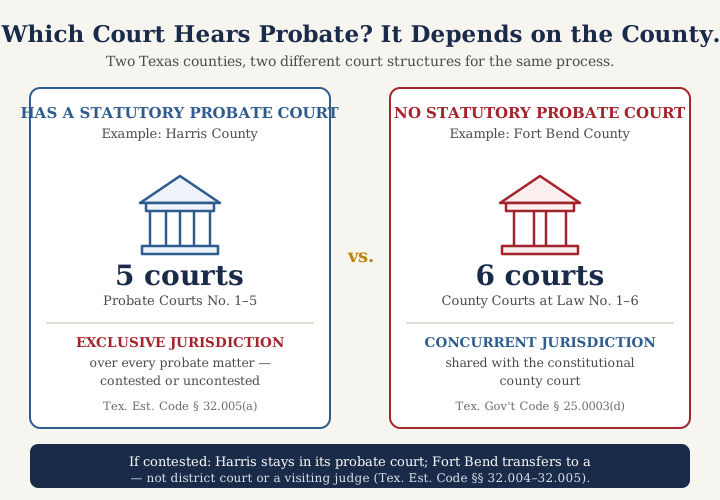
Probate court is the Texas court with authority over a deceased person’s estate. It validates the will (if there is one), appoints an executor or administrator, and oversees the estate until it’s closed. Which court that is depends on your county. In a county with a statutory probate court, like Harris County’s five dedicated probate courts, that court has exclusive jurisdiction over every probate matter, contested or not (Tex. Est. Code § 32.005). In a county without one, like Fort Bend County, the regular county court system handles it instead. Fort Bend routes its probate docket through one of the six County Courts at Law. Romano & Sumner, a Sugar Land probate firm, guides Fort Bend and Harris County families through probate court from the first filing to the final order.
Most people don’t think about “which court” until they’re the one who has to file something. You just lost a parent, you’re holding a will (or wondering if there even is one), and someone tells you the estate has to “go through probate court.” Fair question: what is that, exactly, and which one is it?
Probate court is the Texas court with authority over a deceased person’s estate. It validates the will (if there is one), appoints an executor or administrator, and oversees the estate until it’s closed. Which court that is depends on your county. In a county with a statutory probate court, like Harris County’s five dedicated probate courts, that court has exclusive jurisdiction over every probate matter, contested or not (Tex. Est. Code § 32.005). In a county without one, like Fort Bend County, the regular county court system handles it instead. Fort Bend routes its probate docket through one of the six County Courts at Law. Romano & Sumner, a Sugar Land probate firm, guides Fort Bend and Harris County families through probate court from the first filing to the final order.
Most people don’t think about “which court” until they’re the one who has to file something. You just lost a parent, you’re holding a will (or wondering if there even is one), and someone tells you the estate has to “go through probate court.” Fair question: what is that, exactly, and which one is it?
Probate court is where the entire administration of an estate happens — start to finish. Under Texas law, that’s treated as one continuous proceeding, from the day someone files the application to open the estate until the final distribution and the executor is discharged (Tex. Est. Code § 32.001(d)). Along the way, the same court:
It’s also where the court exercises “pendent and ancillary jurisdiction,” which lets related issues that come up during the estate (like a dispute over who a particular asset belongs to) often get decided in the same case, without opening a separate lawsuit (Tex. Est. Code § 32.001(b)).
This is the part that trips people up, because Texas doesn’t run probate the same way in every county. It comes down to which of three court structures your county actually has, not simply whether it has a dedicated probate court. Here’s how the three break down.
That’s not a Fort Bend quirk. It’s how Texas Government Code § 25.0003(d)–(e) works generally: a statutory county court (“county court at law”) has probate jurisdiction concurrent with the county’s own constitutional county court, unless the county has a statutory probate court, in which case the statutory probate court becomes the only statutory court with probate jurisdiction. Fort Bend has no statutory probate court, so all six of its County Courts at Law share concurrent probate jurisdiction alongside the constitutional county court itself. (Texas law does let a county’s own specific statutes override that default, per § 32.002(b)’s “unless otherwise provided by law” — we checked Fort Bend’s, and nothing overrides it there.)
In short: a court system built entirely around probate (Harris-style), one where probate is shared among general-jurisdiction County Courts at Law (Fort Bend-style), or one where the constitutional county court simply handles it alone (many smaller counties). Three different structures, same underlying process.
Here’s the part that doesn’t show up in any statute. Knowing which type of court you’re in front of (a statutory probate court or a county court at law) only gets you so far. Each individual judge has wide discretion to run their own courtroom the way they want, and that can differ court to court even within the same county: one judge may prefer hearings by Zoom, another may want everyone in the room in person, and each has their own expectations for how a routine matter gets presented. None of that is written down anywhere you can look it up. It’s the kind of thing you only know from being in front of these courts regularly — which is what practicing probate in Fort Bend and Harris Counties every week actually gives us.
This breaks into the same three scenarios above, not two, and which one applies depends on the exact court structure in that county, not just whether it has a statutory probate court. Here’s how a contest actually gets routed in each case.
We watch this third scenario closely, because it’s a real strategic choice, not a formality. In a county without its own statutory probate court, district court can be a perfectly good forum, but the farther that county is from Fort Bend or Harris, the more a case can get home-towned in front of a local jury that doesn’t know an outside family. A statutory probate judge, by contrast, hears nothing but probate and guardianship matters and brings that focus to a contested estate. When we already know we’d want a statutory probate judge if a matter turns contested, Texas law lets us request that assignment conditionally in the initial pleading, before anything is actually contested, and the request simply takes effect if a contest later arises (Tex. Est. Code § 32.003(c)). That’s not something a family gets right by accident; it takes knowing the mechanism exists and building it into the filing from day one.
If you’re not sure which of these three describes your county, or whether your matter is headed toward a contest at all, that’s exactly the kind of question a quick call sorts out fast.
Not quite, and the distinction matters. Probate is the legal process — proving up a will, appointing someone to administer the estate, paying debts, and distributing what’s left. Probate court is the venue where that process plays out. You can’t have one without the other, but when someone says “we’re still in probate,” they usually mean the process is ongoing, not that they’re sitting in a courtroom every week. Most estates that move through independent administration involve only a handful of actual court appearances.
Often, no — at least not the way people picture it. A straightforward, uncontested probate (a valid will, a cooperative family, an executor authorized to act independently) frequently involves a short prove-up hearing rather than a drawn-out court battle. Whether that happens by Zoom or in person depends on the specific court and judge; it’s not the same answer countywide, let alone statewide, which is one more reason it helps to have counsel who appears in front of these courts regularly and already knows what each one expects. Any of that changes the moment a matter becomes contested. At that point, expect the fuller court process that comes with any disputed civil case, including live hearings and, if it doesn’t settle, a trial.
We represent families in front of the probate courts in both Fort Bend and Harris Counties every week. We know which court your estate belongs in, what that court expects, and how to get an uncontested matter through cleanly. If a dispute is brewing, we know how the contested-matter routing actually works in practice, not just on paper. For the full picture of the probate process itself, see our probate administration overview, or call (281) 242-0995 for a free consultation.
No — Texas handles probate three different ways depending on the county. Counties large enough to have a statutory probate court, like Harris County, have a court that hears nothing but probate, guardianship, and mental health cases. Counties without one but with County Courts at Law, like Fort Bend, share probate jurisdiction between those courts and the constitutional county court. Everywhere else — mostly smaller, more rural counties — the constitutional county court handles probate on its own.
Probate is the legal process of settling a deceased person’s estate — validating the will, appointing an executor, paying debts, distributing property. Probate court is simply the court where that process happens.
It depends on what you actually need. If you need someone legally appointed to act for the estate (collecting assets, paying debts, or signing for the sale of property) or you need heirship formally determined so title can pass, then yes, that goes through probate court as an administration, and the court appoints an administrator and determines the heirs under Texas’s intestacy rules. But not every no-will estate needs a full administration: a small, debt-free estate may qualify for a Texas Small Estate Affidavit instead, and some assets (like those with a named beneficiary or held in joint ownership with survivorship rights) pass outside probate entirely, with no court involvement at all.
It depends on the county’s court structure, not just whether it has a statutory probate court. In a county with a statutory probate court (Harris County), that same court hears the contest. In a county with County Courts at Law that already handle probate (Fort Bend County), the contest ends up in one of those County Courts at Law, whether because it started there or because it transfers there (Tex. Est. Code § 32.004), not district court. The option to request a visiting statutory probate judge or move to district court (Tex. Est. Code § 32.003) only exists in smaller counties with neither a statutory probate court nor a County Court at Law handling probate.
Yes. Probate proceedings, including the will itself once it’s admitted, are public court records. That includes the itemized, dollar-valued inventory of the estate’s assets, if one gets filed. We’re conscious of that. Where an independent executor qualifies (no unpaid debts other than secured debts, taxes, or administration expenses), Texas law allows filing a sworn affidavit in lieu of the itemized inventory instead of the inventory itself (Tex. Est. Code § 309.056). Beneficiaries (apart from a narrow set who’ve already been paid out, are owed a small amount, or waived it in writing) still receive the full, detailed inventory directly; the affidavit just keeps the itemized dollar figures out of the public court file.
This article is for general informational purposes only and is not legal advice. Reading it does not create an attorney-client relationship. Every situation is different — for advice about your circumstances, speak with a qualified Texas attorney.
Romano & Sumner’s estate litigation and probate team is led by Paul Romano, Kenneth “Kenny” Sumner Jr., and Nicholas “Nick” Noe — 40+ years of combined experience serving families across Fort Bend and Harris Counties.