

By Nicholas “Nick” Noe, Partner, Romano & Sumner, PLLC.
Quick Answer
If you’re settling an estate in Fort Bend County, Texas law generally gives you four years from the date of death to file the will for probate (Tex. Est. Code § 256.003), and which path you take from there — muniment of title, independent administration, dependent administration, or a small estate affidavit — decides how fast and how expensive it gets. Romano & Sumner is a Sugar Land probate firm that files and handles probate in the Fort Bend County Courts at Law, and a short call with us can tell you which path fits your family’s estate.
If the person who died owned anything titled solely in their name — a house, a car, a bank or brokerage account without a beneficiary designation — that property generally can’t be sold, transferred, or even accessed until a court says who’s legally authorized to act for the estate. That’s what probate does.
A few situations skip full probate entirely: – Everything passed by beneficiary designation or joint ownership (life insurance, retirement accounts, a house held jointly with right of survivorship) — nothing left for a court to transfer. – The estate is small, and there’s no will. Texas allows a small estate affidavit when the estate’s non-exempt assets are worth $75,000 or less, at least 30 days have passed since death, and no one has already applied to be appointed personal representative (Tex. Est. Code § 205.001).
Everyone else — anyone with real property, a solvent estate with debts to pay, or a will that names an executor who needs legal authority to act — is looking at some form of probate. And the clock starts the day the person died: a will generally has to be offered for probate within four years, or the estate may end up treated as if there were no will at all (Tex. Est. Code § 256.003). We cover what probate court actually is and how the whole process fits together in our guide, What Is Probate Court in Texas? — this page is about getting the right lawyer for your specific Fort Bend estate.
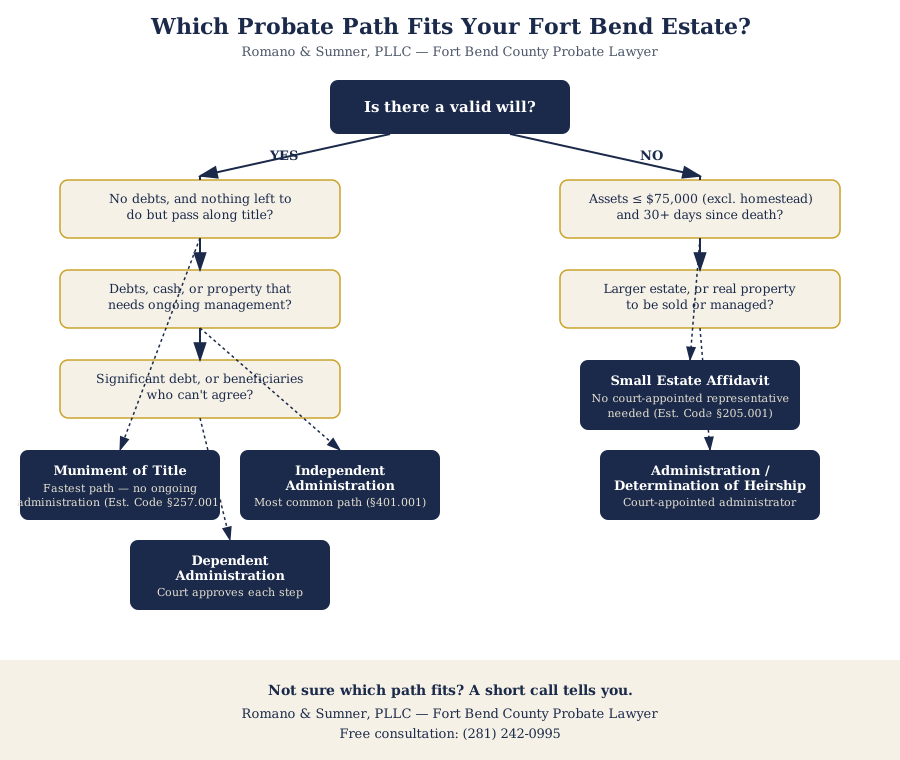
Fort Bend County doesn’t have a separate “probate court.” Because there’s no statutory probate court here, Fort Bend’s county courts at law hold the same probate jurisdiction as the constitutional county court (Tex. Gov’t Code § 25.0003(d)) — so probate matters, including admitting a will, appointing an executor or administrator, guardianships, and related disputes, are filed and heard in the Fort Bend County Courts at Law, in Richmond (§ 25.0811). Which of the four paths applies determines how much the court is involved from there:
| Path | When it fits | Court involvement |
|---|---|---|
| Muniment of title | Valid will, no unpaid debts other than a debt secured by real estate (like a mortgage) | Minimal — one order, no ongoing administration (§ 257.001) |
| Independent administration | Valid will (or heirs agree), some assets or debts to manage | Executor acts with little day-to-day court oversight — the most common path in Texas (§ 401.001) |
| Dependent administration | Significant debt, or beneficiaries who can’t agree | Court approves nearly every step the administrator takes |
| Small estate affidavit | No will, estate ≤ $75,000 (excluding homestead/exempt property) | No personal representative appointed at all (§ 205.001) |
Independent administration is the path most Fort Bend estates end up on — it’s faster and less expensive because the executor doesn’t need a judge’s sign-off for routine decisions. Dependent administration exists for the harder cases: real disputes among beneficiaries, or debts large enough that creditors need a court looking over the process. We walk through that comparison in full, with the tradeoffs of each, in Independent vs. Dependent Administration in Texas.
We’ve handled probate matters in the Fort Bend County Courts at Law for years — filing the initial application, getting executors and administrators appointed, and carrying estates through to closing. When we take on a Fort Bend probate matter, we:
That trap isn’t abstract — it plays out in a specific way right here in Fort Bend County.
Fort Bend County Courts at Law are serious about protecting minors’ interests. That means it’s much harder in Fort Bend County to get an independent administration approved when there’s no will and there are minor heirs. The code permits it in particular circumstances, but the Fort Bend courts often require more before they’ll allow it. That distinction matters for cost: a dependent administration is significantly more expensive than an independent one, and a failed attempt at independent administration followed by a fallback to dependent administration is more expensive still. With Romano & Sumner, we get it right the first time.
Romano & Sumner is a probate, guardianship, and estate-litigation firm based in Sugar Land, in the heart of Fort Bend County. Probate administration is one of the core things we do every week, not a service we added on. When a family is trying to figure out what happens to a house, an account, or an estate after someone dies, we’re the people who know exactly which door to walk through — and we’ll tell you plainly if your situation is simple enough to move through quickly, or complicated enough to need real handling.
Get a straight answer about your estate. A short, free call tells you which probate path applies and what it will take. Call (281) 242-0995 or reach us through our contact page.
Probate matters at Romano & Sumner are handled by our partners — Paul Romano, Kenneth “Kenny” Sumner Jr., and Nicholas “Nick” Noe. Paul Romano is Board Certified in Estate Planning and Probate Law by the Texas Board of Legal Specialization — a certification that covers this exact area of practice.
Ready to move forward? Call (281) 242-0995 for a free consultation, or reach us through our contact page. Bring whatever paperwork you have — a death certificate, a copy of the will if there is one, and any account statements you can find.
It depends on which path fits your estate and whether anyone contests it. Independent administration — the most common path — is generally the least expensive because it needs the least court involvement. We’ll walk through the likely path and the honest cost at your free consultation.
Not always. If the estate’s non-exempt assets are worth $75,000 or less and at least 30 days have passed since death, a small estate affidavit can transfer the estate without a full administration (Tex. Est. Code § 205.001). Larger or more complicated estates without a will still generally need a court-appointed administrator.
Independent administration lets the executor act with minimal court oversight once appointed — the most common and least expensive path in Texas (Tex. Est. Code § 401.001). Dependent administration requires court approval for nearly every step, and typically comes up when there’s significant estate debt or beneficiaries who can’t agree. See the full comparison in Independent vs. Dependent Administration in Texas.
It depends heavily on which path applies. An uncontested independent administration (or a muniment of title) typically wraps up in a matter of months. A dependent or contested administration can run several months to a year or more. The clearest way to know your timeline is a conversation with a Fort Bend probate lawyer about your specific estate.
Fort Bend County has no separate statutory probate court, so its county courts at law hold the same probate jurisdiction as the constitutional county court (Tex. Gov’t Code § 25.0003(d)). Probate matters — including wills, estate administrations, and guardianships — are filed and heard there, in Richmond (§ 25.0811).
A short call with a Fort Bend probate lawyer tells you which path applies and what happens next. Call (281) 242-0995 or reach us through our contact page.
This article is for general informational purposes only and is not legal advice, and it is not a promise or guarantee of any particular result. Reading it does not create an attorney-client relationship. Every situation is different. For advice about your circumstances, speak with a qualified Texas attorney.